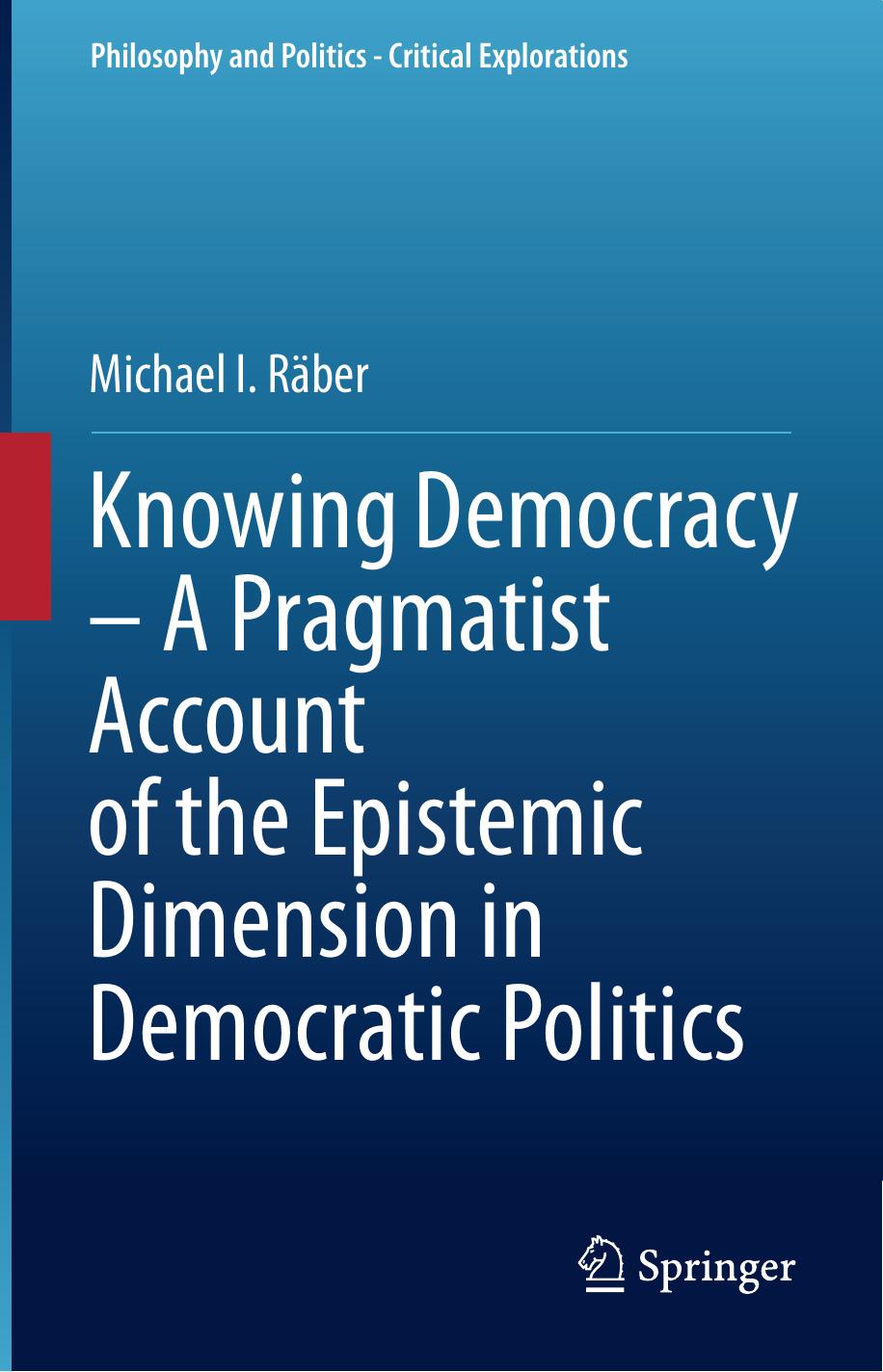
Knowing Democracy â A Pragmatist Account of the Epistemic Dimension in Democratic Politics by Michael I. Räber
Author:Michael I. Räber
Language: eng
Format: epub, pdf
ISBN: 9783030532581
Publisher: Springer International Publishing
5.1 Judicial Judgments and Democracy: The Jury Justified
In this section I link Deweyâs theory of judgment to arguments suggesting that the jury is an example of a democratic institution that can be justified (at least partially) instrumentally, and that the type of judgment members of the jury exert partially mirrors political judgments. The argument for the idea that members of a jury are capable of making competent judgments is twofold. First, I will provide a very short historical outline of this idea by showing that jury eligibility is historically of the same origin as the idea that members of a demos are capable of making competent judgments. Second, I will interpret some justifications of the institution of lay juries made by the US Supreme Court on the basis of the ideals of representativeness and citizenship as epistemic justifications of this institution. If lay juries can be justified (at least partially) in epistemic terms and if lay juries are to be considered as a democratic institution, then the justification of lay juries can be taken as a proxy for the justification of other democratic institutions and democracy in general.1
One reason why the jury exemplifies the epistemic justification of democratic institutions writ large is historical. In ancient Greece, deciding politically and judging as jurors have constituted the two basic activities of democratic citizens. In Athens, for example, citizens had the right to attend the assembly, the council, and other bodies, or to sit on juries. This fact is reflected in Aristotleâs definition of the citizen, which he defines in the Politics as a person who has the right to participate in deliberative and judicial office:Who the citizen is, then, is evident [â¦]. Whoever is entitled to participate in an office involving deliberation or decision is, we can now say, a citizen in this city. (Aristotle 2010, 87; 1275b 18â21)2
Download
Knowing Democracy â A Pragmatist Account of the Epistemic Dimension in Democratic Politics by Michael I. Räber.pdf
This site does not store any files on its server. We only index and link to content provided by other sites. Please contact the content providers to delete copyright contents if any and email us, we'll remove relevant links or contents immediately.
| Anthropology | Archaeology |
| Philosophy | Politics & Government |
| Social Sciences | Sociology |
| Women's Studies |
The remains of the day by Kazuo Ishiguro(9229)
Tools of Titans by Timothy Ferriss(8605)
Giovanni's Room by James Baldwin(7578)
The Black Swan by Nassim Nicholas Taleb(7289)
Inner Engineering: A Yogi's Guide to Joy by Sadhguru(6907)
The Way of Zen by Alan W. Watts(6737)
The Power of Now: A Guide to Spiritual Enlightenment by Eckhart Tolle(5932)
Asking the Right Questions: A Guide to Critical Thinking by M. Neil Browne & Stuart M. Keeley(5902)
The Six Wives Of Henry VIII (WOMEN IN HISTORY) by Fraser Antonia(5613)
Astrophysics for People in a Hurry by Neil DeGrasse Tyson(5282)
Housekeeping by Marilynne Robinson(4606)
Double Down (Diary of a Wimpy Kid Book 11) by Jeff Kinney(4416)
Skin in the Game by Nassim Nicholas Taleb(4406)
Ikigai by Héctor García & Francesc Miralles(4405)
12 Rules for Life by Jordan B. Peterson(4388)
The Ethical Slut by Janet W. Hardy(4365)
The Art of Happiness by The Dalai Lama(4241)
Skin in the Game: Hidden Asymmetries in Daily Life by Nassim Nicholas Taleb(4130)
Walking by Henry David Thoreau(4085)
